CYBERPUNK
REALITY
SEIZEFREEZE / RESEARCH LAB 2.0Cortical lab ↗

COMPUTATIONAL RESEARCH / NO BIOLOGICAL EXPERIMENTS REPORTED

SeizeFreeze Research Lab

Inspect the reported prototype. Run a virtual experiment. Challenge its assumptions.

ILLUSTRATIVE GEOMETRY · COMPUTED RADIAL TEMPERATURES

Organoid Research Workbench

MODEL / NOT MICROSCOPY
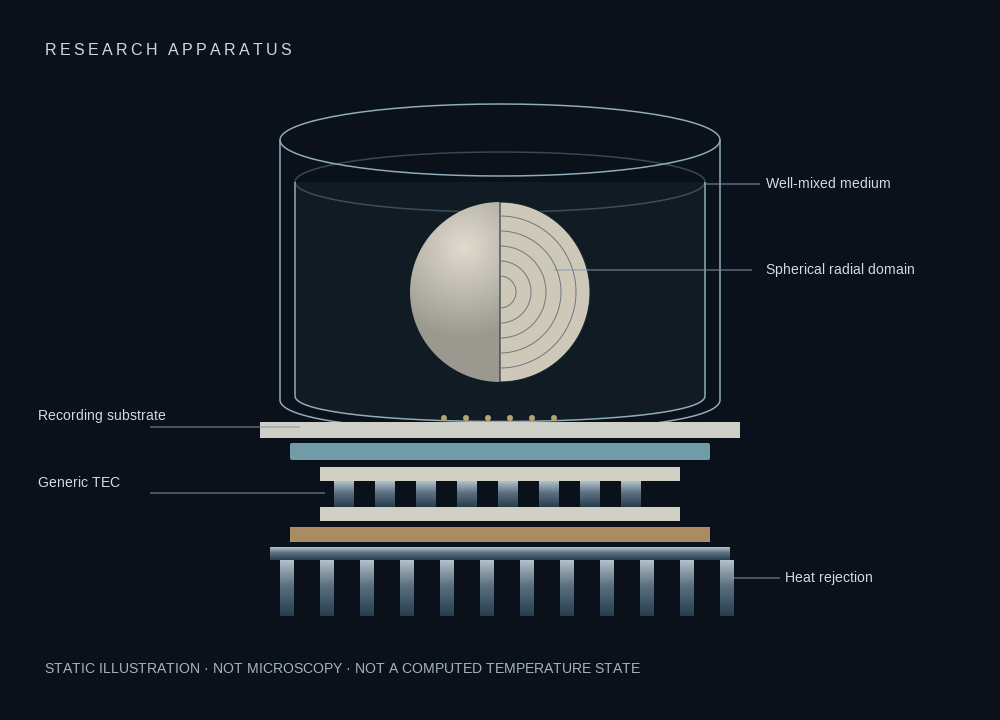
Static explanatory schematic of a spherical thermal article, surrounding medium, recording substrate and thermoelectric heat path. This diagram contains no computed temperatures.

Preparing the interactive apparatus…

Drag to orbit · + / − to zoom
0.00 s

Computed thermal state · no measured organoid data

A nonperfused spherical thermal article in well-mixed medium. Colors map computed radial shells; no local biological effect is predicted. Geometry is illustrative, with apparatus dimensions assumed.

↗ Cyan: extraction↗ Amber: hot-side heat∿ Violet: synthetic activity◇ Gray: unresolved

ONE CLOCK / SYNTHETIC RECORDINGS + THERMAL SIMULATION

Inspect the experiment

0.00 s
0 s60 s120 s

Thermal response, recording and event estimates share this timeline. Cooling never normalizes the synthetic signal.

Tissue mean / ΔT simulated
— K
Medium sensor / ΔT synthetic
— K
Hot side / ΔT simulated
— K
Current / requested → actual
— A
Synthetic extracellular voltage

Synthetic voltage only. Threshold estimates are illustrative; no measured recording or validated spike sorter.

Synthetic network raster8 channels · 120 s

Population rate below the raster: violet is the estimated feature; neutral dashed is assumed source events per quarter-second, converted to events/s. Violet marks: assumed source events. Neutral circles: threshold estimates. Amber bands: injected recording artifacts. A synthetic burst is not a seizure diagnosis.

Thermal trajectoriesΔT / K from inert reference

Cyan: tissue mean · neutral: medium · amber: hot side · dotted: independently computed sham. All temperatures are model outputs. The arbitrary 20 °C default reference is not a biological operating condition.

Detection and actuationIllustrative estimates / A

The detector estimates population events. It has no established seizure-detection performance. Dashed blue: requested current; solid blue: actual current constrained by the model and simulated fault logic.

INSTANTANEOUS HEAT / WHOLE-SYSTEM STORAGE

Where the energy goes

Cold-side extraction plus TEC electrical input appears at the hot side. Tissue, medium and device storage are accounted for once.

Medium → cold / Qcontact
— W
TEC extraction / Qc
— W
TEC voltage / derived model
— V
Electrical input / P
— W
Hot-side delivery / Qh
— W
Hot → environment
— W
TEC electrical energy / cumulative
— J
Stored thermal change / ΔU
— J
Net external energy
— J
Conservation residual
— J
Inspect equations, parameters and numerical diagnostics

The tissue domain is a nonperfused sphere with a uniform surface boundary to a finite, well-mixed medium. The medium connects to a cold substrate through an assumed resistance. It is a different physical model from the perfused adult-cortex depth column.

Radial conduction

Temperature changes through radial conduction. No perfusion, metabolic source or neural response is included.

ρ / c
Assumed density, kg/m³; heat capacity, J/(kg K)
k / r / T / t
Conductivity W/(m K); radius m; temperature °C; time s
Status
Approximate spherical finite-volume model; symmetry at center and uniform medium coupling at surface

Thermoelectric energy transfer

Current pumps heat, Joule heating opposes extraction, and conduction leaks heat across the element. Heat delivered at the hot face includes electrical power.

Qc / Qh / P
Cold extraction, hot delivery and electrical input, W
α / I / Re / K
Assumed module V/K, A, Ω and W/K; Tc,K uses kelvin
Status
Constant-property lumped approximation; not fitted to the reported prototype

Active inputs and units / all modeling assumptions
InputValueUnit

Full equations, provenance and numerical method ↗ · Original cortical model ↗ · Manufacturer equation reference ↗

Reproduce this virtual experiment

Exports identify computational outputs, synthetic signals, all assumptions, the random seed, model version and analysis plan. They contain no biological measurements.

PRECLINICAL DEVELOPMENT / EVIDENCE GATES

What would reduce uncertainty

Full validation plan ↗
  1. 01

    Identify and document the hardware

    Current status: three user-reported component classes. Pass criterion: independently understandable parts, firmware, wiring and provenance records.

    User-reported
  2. 02

    Characterize an inert thermal system

    Compare independently measured electrical input, face and test-article temperatures, storage and rejection with predeclared model predictions and error budgets.

    Proposed
  3. 03

    Validate the acquisition chain

    Establish scaling, reference, timing, noise, coupling and actuator artifacts. Consumer EEG demonstrations and specialized neural assays require separate evidence.

    Proposed
  4. 04

    Evaluate biological research feasibility

    Qualified collaborators assess model relevance, assay quality, controls, independent thermometry, viability, reproducibility and required institutional oversight.

    Proposed
  5. 05

    Assess what the evidence supports

    Trace every conclusion to measurements and controls. Distinguish organoid observations from adult cortical physiology, an implanted device and human treatment.

    Proposed