Watch
Follow a continuous view of leading-strand synthesis and the repeating steps that build lagging-strand fragments.
DNA replication · An interactive molecular experience
One fork. Two strands. A living molecular machine.
Follow the proteins that open DNA, copy its instructions, and join the new strands. Follow the handoffs in motion, orbit the running fork, and pull individual enzymes off the DNA to see what changes. Replay a reaction slowly or build an Okazaki fragment yourself.
Inside the replication fork
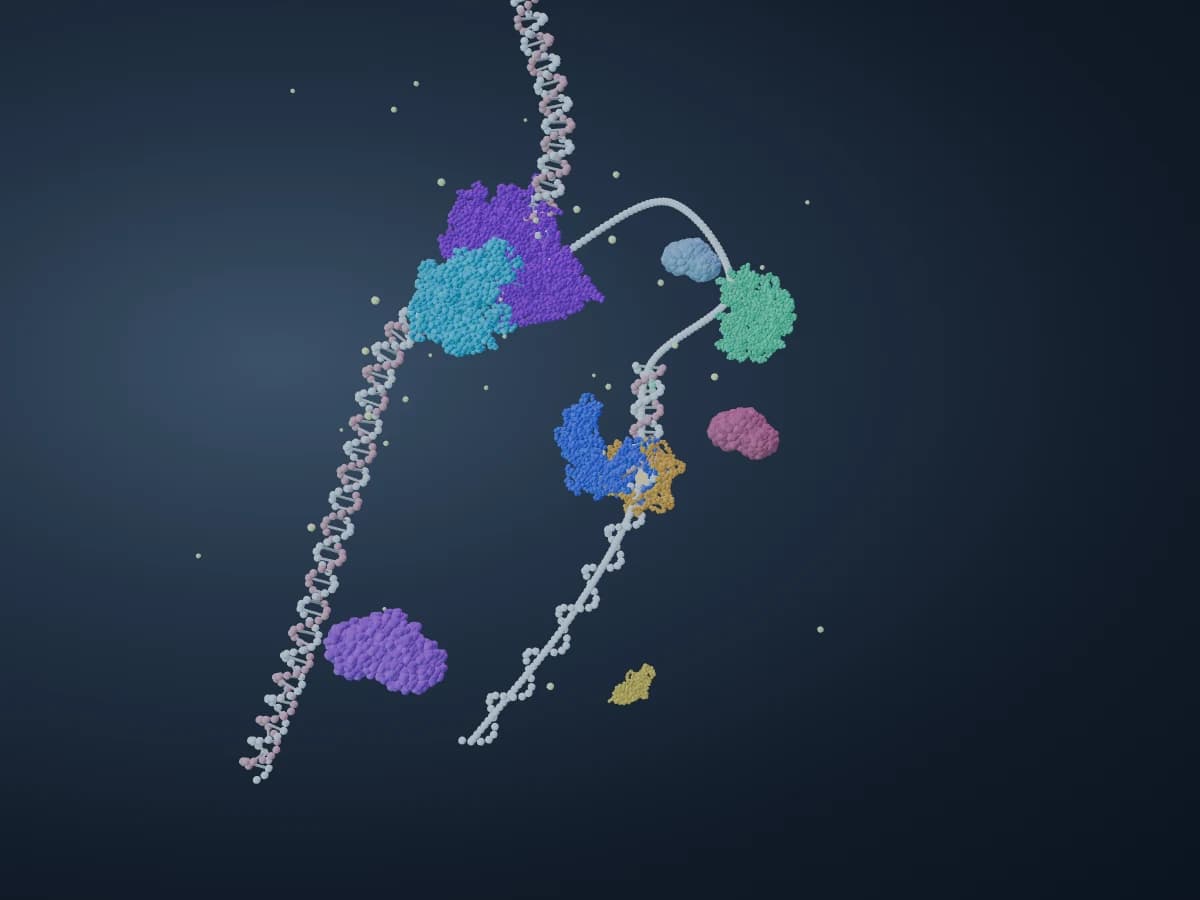
One fork. Two strands.
Watch · Explore · PlayChoose Watch, Explore, or Play inside the experience. Space pauses playback; L toggles labels. In Explore, drag to orbit and pinch or scroll to zoom. Closing the experience ends the current session.
Follow a continuous view of leading-strand synthesis and the repeating steps that build lagging-strand fragments.
Orbit the machine in motion, follow an enzyme, and remove or restore it. Watch copying stall or unsealed nicks accumulate.
Place a primer, load the clamp, choose a polymerase, pair nucleotides, and process and seal a fragment.
Evidence & interpretation
The protein models draw on deposited structures from 7PFO, 6TNZ, and 8QJ7. Their arrangement, movement, reaction timing, and displayed ATP accounting are illustrative.
This is an educational model. It combines separately solved complexes; it does not represent a validated atomistic trajectory of the complete replisome. Open “Sources & model notes” inside the experience for provenance and simplifications.
The optional MCAT lens adds five visual labs and an original three-question transfer checkpoint. Predict before revealing a mechanism, then examine why each alternative succeeds or fails. It supports replication reasoning; a short checkpoint cannot establish exam readiness.
Runs in your browser. WebGL2 is required for the 3D view. Sound starts muted; motion and rendering quality can be adjusted inside the experience.